

Marketing work inside a Shopify business rarely breaks because the team has no ideas. It breaks because the work between the idea and the published asset is scattered across too many places.
A product manager updates a product page. A founder writes a rough campaign brief in a doc. Someone asks an agency for ad copy. Someone else rewrites the same offer for email, then adapts it for Instagram, then remembers the SEO title still needs work. By the time the campaign is live, half the energy has gone into coordination rather than the message itself.
This is the gap Maya is built for.
Maya is Yep AI’s AI Marketing Specialist, designed for Shopify merchants who need consistent, on-brand content without building a larger marketing team. She plans, writes, generates creative, publishes content, and tracks what happens after the work goes live, using the product and store context already inside your Shopify business.
Generic AI writing tools start with a blank prompt box. Maya starts with the store.
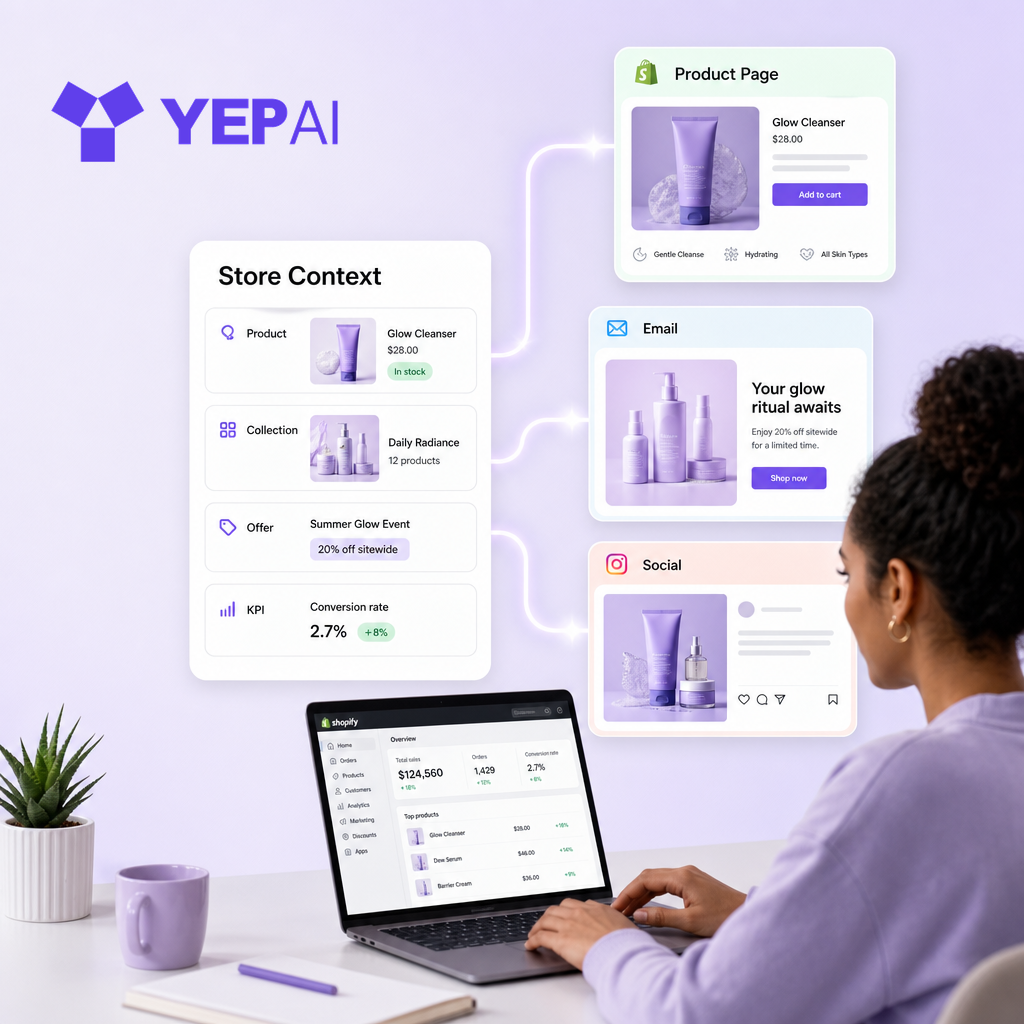
A Shopify merchant does not need a prettier paragraph in isolation. The useful work is tied to a product, a collection, a promotion, a channel, and a business goal.
That is why Maya is built as a content workspace rather than a standalone writing assistant. The workflow begins with structured briefs, real catalog data, product performance signals, brand voice, and publishing destinations. The goal is to reduce the manual work between planning and launch while keeping the output grounded in what the store is actually selling.
For a product page, Maya can select a product from the Shopify catalog, use the available product details, review performance inputs such as CTR, CVR, and sales where available, and produce a complete product content package. That can include the product description, bullet points, FAQ, and SEO metadata.
For a seasonal campaign, Maya can turn one campaign idea into a set of assets across the funnel: campaign page copy, promotional copy, SMS, ad copy, and email campaigns. The same offer and KPI stay consistent across channels, instead of being rewritten from scratch every time a new format is needed.
The difference is practical. A merchant does not brief five disconnected tools. Maya works from one source of context and carries it through the content flow.
Yep AI is organized around digital staff for e-commerce operations. Anna supports customer service. Alex supports sales and cart recovery. Cody supports catalog and SEO work. Maya now owns the marketing layer: content, campaign assets, social publishing, image generation, video generation, and performance feedback.
This matters because marketing does not sit outside the rest of commerce operations. A product description affects SEO and conversion. A campaign email affects customer questions. A social post affects product demand. A landing page affects what Alex can sell and what Anna may need to answer later.
Maya is part of the same system, not a separate tool with no memory of the store. She is designed to use the same shared context that makes Yep AI’s digital staff useful across customer service, sales, catalog, and marketing.
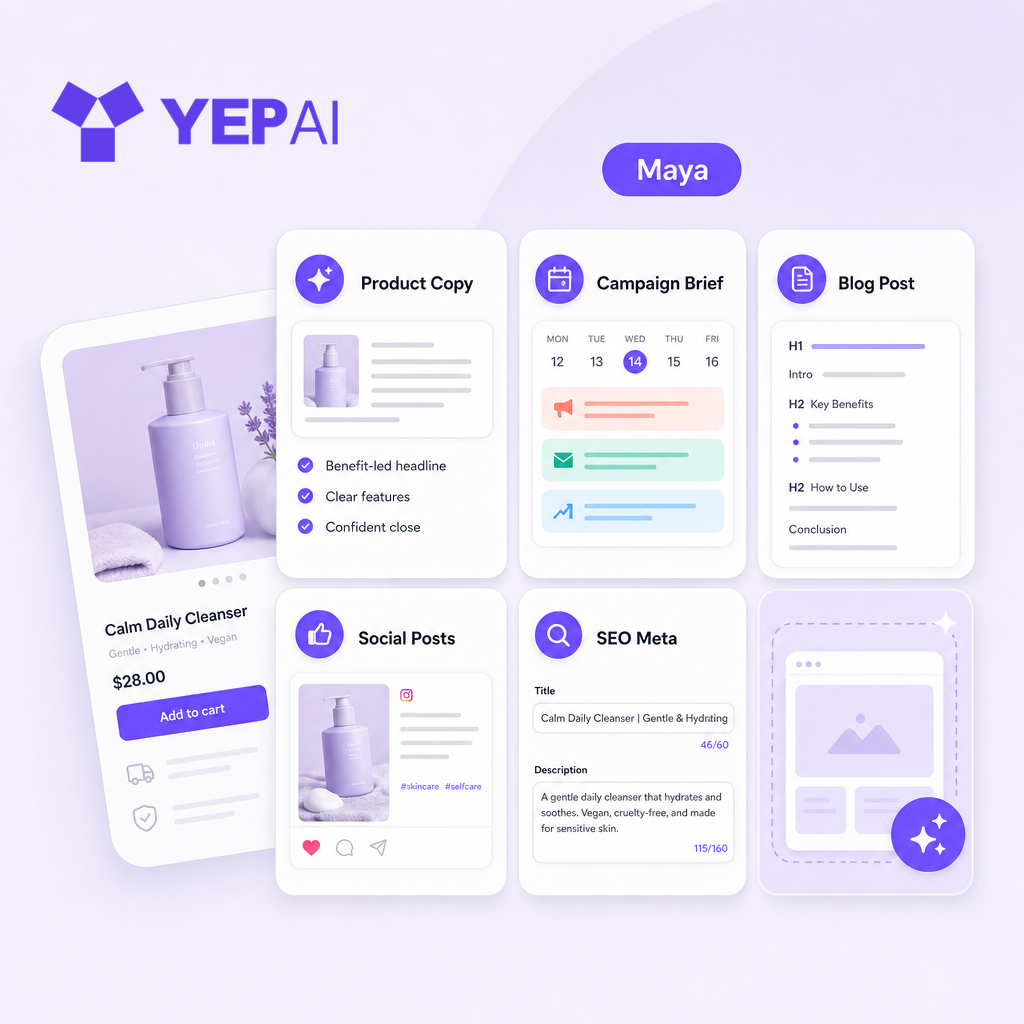
Maya launches with five core content workflows.
Product description
Merchants can choose a product directly from their Shopify catalog and generate a full product page package. Maya can draft the description, selling points, FAQ, and SEO metadata, then prepare the content for publishing back to the relevant product page.
This is built for teams that know their products but do not want every product update to become a copywriting task.
Campaign brief
Seasonal promotions create a lot of repetitive work. Black Friday, Cyber Monday, Mother’s Day, Valentine’s Day, Christmas, flash sales, and collection drops all need a clear offer translated into multiple assets.
Maya turns one campaign brief into a multi-channel package. The campaign page, promotion copy, SMS, ad copy, and email content all follow the same core offer, theme, and target KPI.
Blog post
Organic traffic still matters for Shopify merchants, but long-form content is often pushed aside because it takes time to brief, draft, optimize, and publish.
Maya can generate keyword-targeted buying guides, collection SEO articles, and long-form blog posts from a structured brief. Merchants can define the topic, target SEO keywords, audience, and length, then publish directly to their Shopify store blog.
Social media posts
Social content needs channel fit, not copied-and-pasted captions. Maya can generate posts for Instagram, Facebook, and LinkedIn from product or campaign context, with platform-native captions and relevant hashtags. Each post can take a different angle while staying tied to the same product truth.
The point is not to flood channels with more generic posts. The point is to make useful distribution easier for teams that already have too many operational tasks on the calendar.
Meta title and description
SEO metadata is small, but it is easy to skip. Maya can generate meta titles and descriptions for product pages, collection pages, blog posts, landing pages, and homepages, with character limits built into the workflow. The output can then be written back to the page’s SEO fields.
Many growing Shopify teams have a brand voice, but the rules are informal. The founder knows what sounds right. The agency knows the old campaign style. The person writing social has a different version again.
Maya’s Brand Voice module is built to make that knowledge usable. Merchants can upload brand guidelines, tone examples, and sample posts. Maya can extract voice rules, learn banned words, and apply the same voice across product pages, campaigns, blogs, emails, and social posts.
This gives teams a stronger baseline. A founder may still edit. A marketer may still adjust the angle. But the first draft starts closer to the brand, which saves time and reduces the drift that happens when every channel is written in a different place.
Text is only one part of the campaign. Product launches, sale events, and social campaigns also need visuals.
Maya includes image generation so merchants can create visuals from the same product, campaign, and Brand Voice context used for the copy. A merchant can generate contextual images for a product or campaign without writing a second prompt in a separate tool.
At launch, this can support product shots, lifestyle scenes, promo banners, offer cards, and ad creative. Image Studio gives the same capability a dedicated workspace for merchants who want to focus on visual assets first.
Video generation is also part of Maya’s roadmap. The planned Video Studio will help turn product and campaign content into short-form videos, including product showcases, promotion teasers, and social-ready clips for formats such as Reels, Stories, and feed videos.
The important part is consistency. Copy, images, and video should come from the same product truth and campaign brief.
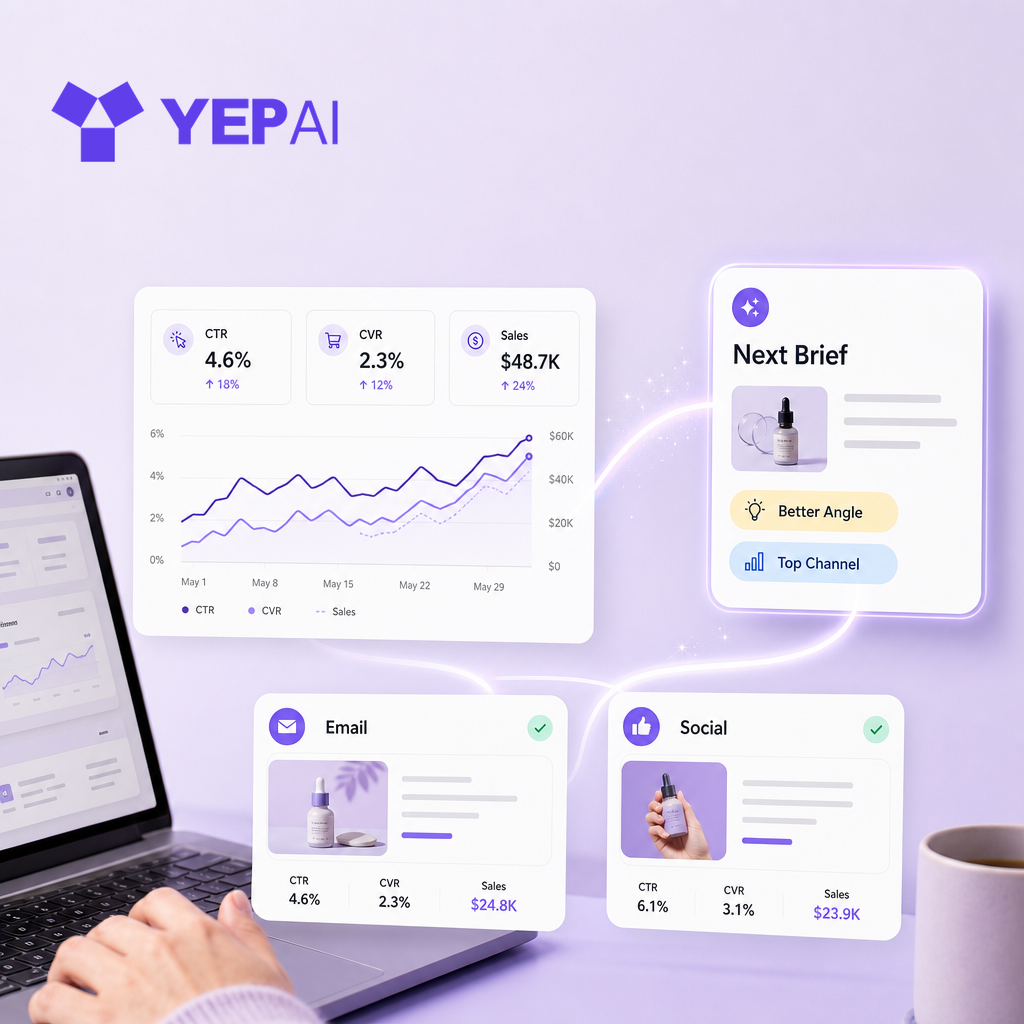
Publishing is not the end of the marketing workflow. It is the point where the store starts telling you what worked.
Maya’s performance tracking is designed to connect content back to outcomes. Merchants will be able to track CTR, CVR, engagement, and sales by content type, channel, and campaign. For rewritten product pages, before-and-after comparisons can show whether the new page improved performance.
That feedback can then guide the next generation. If one angle performs better for a product category, Maya should use that signal. If a campaign channel underperforms, the next brief should reflect it.
Yep AI already supports 1,000+ registered users across its platform, with early customers across solar, energy, and finance including AUS Solar, Dodo Solar, T-Power, and Pioneer Wealth. Maya extends the same operating principle into marketing: give merchants a secure AI agent that works with store context, not a collection of disconnected prompts.
Most Shopify merchants do not have the luxury of a large in-house content team. Many choose between manual work, agency cost, or scattered AI tools that still require someone to manage every step.
Maya is built for the team that needs to move faster without lowering the standard of the work. She brings planning, generation, editing, publishing, creative production, and performance tracking into one marketing workspace connected to Shopify.
That does not remove the merchant’s judgment. It gives that judgment a better operating system.
Maya joins Yep AI’s digital staff to help Shopify merchants turn store data into content that is easier to produce, easier to publish, and easier to improve over time.
Start with your next product page, campaign, blog post, or social push at yepai.io.